
Global Surrealist Photography
Researcher Lauren Walden reflects here on a recent archival research trip to Paris.
I’ve been fortunate enough to receive joint funding from the Association of Art Historians and RAAD for a week-long trip to archives and libraries in Paris. In this project, I aim to combine unpublished elements of my PhD thesis with new research to form a monograph entitled Global Surrealist Photography: A Cosmopolitan Lens. Theoretically, the monograph interrogates cosmopolitan tensions between universality and cultural specificity in relation to Surrealism. Empirically, photography is couched as a form of international exchange.
My trip to Paris enabled me to further the third chapter of my thesis. Chapter three will contrast two Surrealist photographers, Man Ray and Roger Parry in a chapter provisionally entitled Island Surrealism: From Spiritual Sculptures to Societal Critique. Here, I interrogate the 1926 exhibition Tableaux de Man Ray et Objets des Iles at the Galerie Surréalisteas well as Roger Parry’s sojourn in Tahiti in 1932.
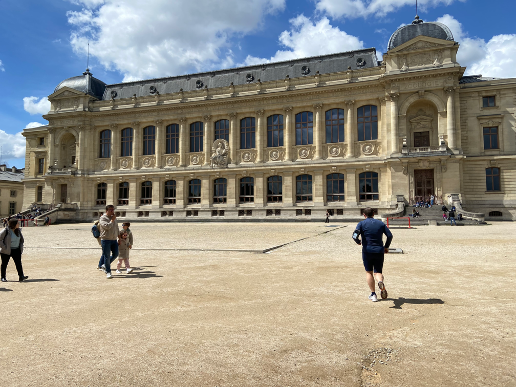
The Muséum D’Histoire Naturelle (Former Trocadéro), The site of many Parisian Avant-garde pilgrimages
The 1926 exhibition focusses on Man Ray’s photographs of sculpture from Sumatra, Hawaii, Papua New Guinea and New Caledonia. Man Ray’s photography eschews ethnographic taxonomy reconciling avant-garde ideas with a myriad of worldwide religious beliefs, elevating these sculptures to Fine Art through displaying them as equals to his own work in a universalist sense. Nevertheless, inculcations of aesthetic mystique are compounded by Surrealist complicity in a colonial art market which was ironically instrumentalised to advocate for anti-colonial ideas. At the archives of the Muséum D’Histoire Naturelle (the former Trocadéro and major French collection of art beyond western borders during the modernist era), I was able to further trace object histories and actors.
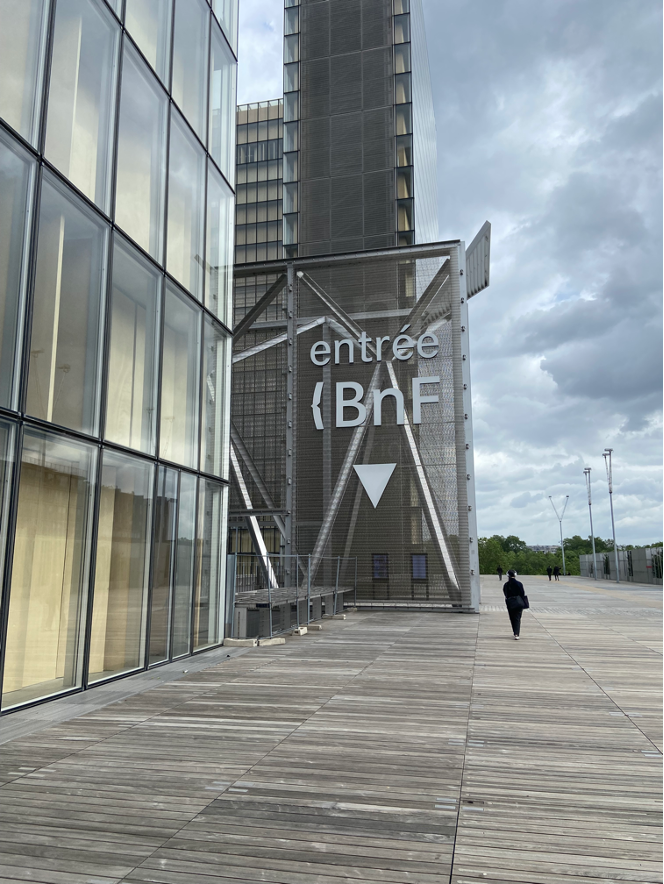
The Bibliothèque Nationale de France.
Counter to Man Ray’s metaphysical exploration of Oceania, Roger Parry’s approach is more telluric. In his Tahitian travelogue, he intersperses images of indigenous Tahitians, the Chinese community and French colonialists. Counter to Man Ray’s aura of mystique, paradisical visions are rendered prosaic through Surrealist documentary photography revealing culturally specific insights.
Through triangulating these groupings, Parry’s juxtapositions critique colonial power dynamics. At the Bibliothèque Nationale de France, I was able to consult Parry’s rare photographic travelogue published with Gallimard in 1934 alongside an exhibition catalogue retrospective of Parry’s work hosted in Tahiti.
Ultimately, both of these cases speak to feminist-cosmopolitan philosopher Seyla Benhabib’s (1992) continuum of the ‘Generalised Other’ and the ‘Concrete Other’.
For Benhabib (1992), the generalised other involves: ‘a Universalistic commitment to the consideration of every human individual as being worthy of universal moral respect’ but also can ‘abstract from the individuality and concrete identity of the other’ (Benhabib and Cornell: 1987) whereas the concrete other ‘requires us to view each and every rational being as an individual with a concrete history, identity, and affective-emotional constitution’ (Benhabib and Cornell: 1987).
References
Benhabib, Seyla, and Drucilla Cornell. 1987. Feminism as Critique: On the Politics of Gender. Minneapolis, MN: University of Minnesota Press
Benhabib, Seyla. 1992. Situating the Self: Gender, Community, and Postmodernism in Contemporary Ethics. New York, NY: Routledge