
Living with the Grid
Reflections on Grid Imaginaries in Art and Culture
What does it take to make electricity visible? Not in the engineering sense with the diagrams, load curves and transmission maps, but in the fuller sense of rendering it perceptible as a force which is political, material, and unevenly powered? This question ran as a constant through all three sessions of Grid Imaginaries, a three part event series hosted by the Technologies & Ecologies Research Group of RAAD at Birmingham City University and organised by Theo Reeves-Evison and Becky Shaw. Each session brought together an artist and a scholar working at, or across, the boundary between the technical and the cultural. The discussions brought up the question of visibility and distribution of electricity from different angles.
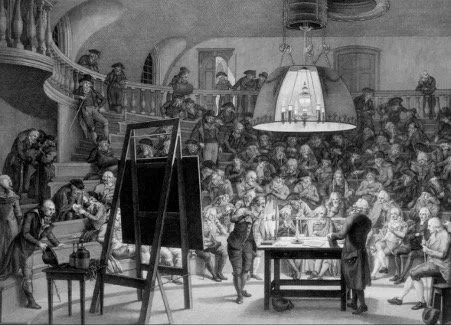
The hall of the physics of Felix Meritis (Amsterdam, NL), engraving after J. Kuyper, 1794
The first session paired artist Marjolijn Dijkman with cultural theorist Dom Davies. Dijkman's practice circles around a fundamental estrangement: electricity in the contemporary West is almost entirely invisible, absorbed into the walls and mostly silent, encountered only as the seamless availability of power. Her research has taken her back to the Enlightenment, when electrical demonstration was theatrical, olfactory, and frankly dangerous, and forward to the present contradictions of the green energy transition. Dijkman's presentation centred on her collaborative body of work ‘Enough Room for Space’ an independent art initiative she founded with Maarten Vanden Eynde in 2005. Working within this initiative, On-Trade-Off was a six-year collaborative project between 2018-2024, co-initiated with PICA in Lubumbashi, Democratic Republic of Congo. The project examined a prospective lithium mine located on a historic Belgian colonial tin mining site in Manono, in the north of the region of Katanga. Through high-voltage photography, artificial fulgurites cast from sand sampled from extractive sites, and a film structured around the names of electrical units, Dijkman rendered the infrastructures of energy visible as entangled histories of colonialism, extraction, and standardisation.
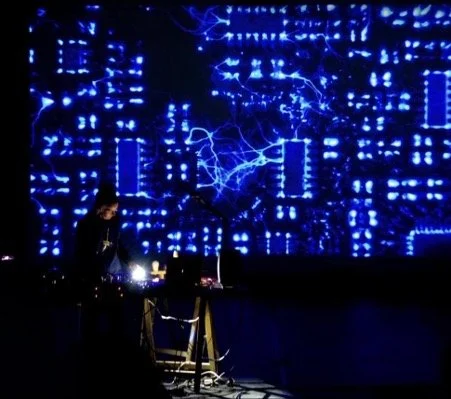
Electrify Everything, Marjolijn Dijkman, Biennale NOVA_XX, Paris, FR (2024) photo: Amélie Bouvier
In her performance work, it pushes this into direct confrontation with the public. Charging Tesla Crash, a Speculation (2019), a collaboration between Jean Katambayi, Sammy Baloji, Daddy Tshikaya, and Dijkman, developed for the 6th Lubumbashi Biennale, staged this most viscerally. A handmade Tesla coil discharged three million volts across a 1:1 scale model of a Tesla Model X car, built from copper wire using a weaving technique derived from children's toy-making traditions in the DRC. The phrase "Electrify Everything," simultaneously a techno-optimist rallying cry and, as Dijkman put it, something Mary Shelley would have found terrifying, captures exactly what the work made felt: the sparks were enormous and deadly, genuinely sublime. It was precisely this uncontrollability that the work sought to restore to public experience.
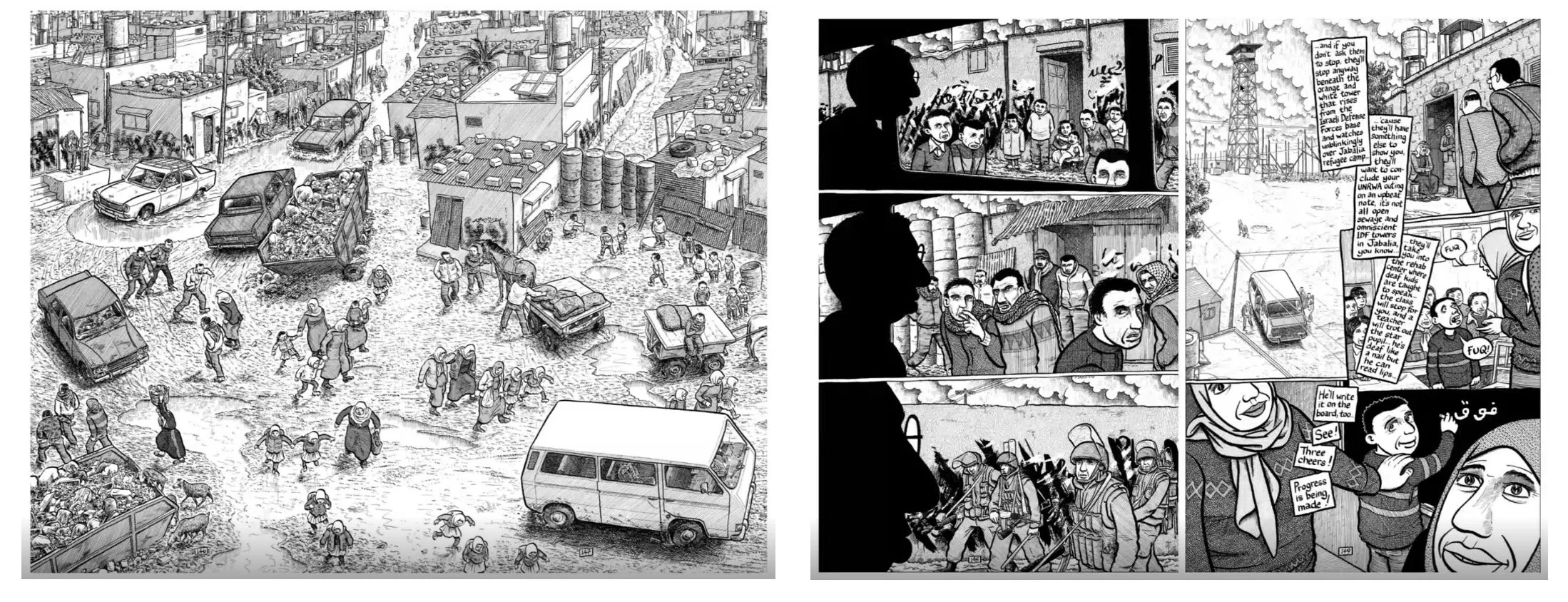
‘Palestine’, graphic journal written and drawn by Joe Sacco, 2003
Dom Davies's contribution approached the invisible from a different direction. His talk, Power Grids, traced a formal and historical affiliation between the grid of the electricity network and the grid of the comics page; not as coincidence but as a shared technology of spatial organisation with roots in colonial modernity. Both grids, he argued, are technologies of governmentality: means of parcelling space, imposing legibility, making territory exploitable. His readings of Léopold Lambert, Joe Sacco's Palestine, and the Instagram comics of Mazen Kerbaj showed the comics grid functioning simultaneously as a tool of narrative and an instrument of surveillance and dispossession, particularly in contexts where being off-grid means not freedom but abandonment. Davies's community energy workshops, in which participants used comics grids as storytelling templates for their experiences of infrastructure, offered a constructive counterpoint: the grid as scaffold for accounts that might otherwise have no form.
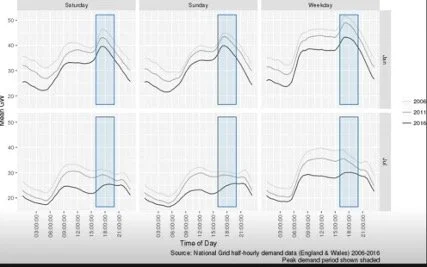
Ben Anderson and Jacopo Torriti. "Explaining shifts in UK electricity demand using time use data from 1974 to 2014." Energy Policy 123 (2018): 544-557
The second session shifted from the spectacular to the intimate. Human geographer Veronica Jacome opened with load curves: those smooth visualisations of aggregate electricity demand that picture, collective human behaviour. Her research moves against this abstraction, attending instead to the embodied, sensory experience of living with a grid that is unreliable, variable, and often unjust. Five years of fieldwork in Tanzania, where small voltage monitors installed in individual household outlets revealed radical variation between neighbours connected to the same transformer, produced a methodology she described in Lefebvrean terms: to grasp the rhythm of the grid, one must have been grasped by it. Her film curation practice extended this argument aesthetically; what would it mean to represent experiences of living from within the grid rather than from above, without spectacularising the body or the infrastructure?
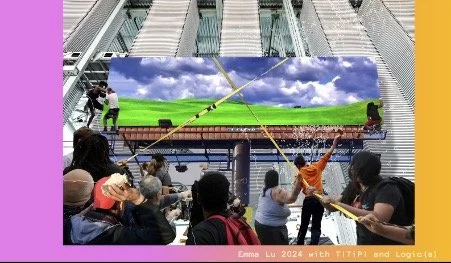
Emma Lu, 2024 with TiTiPl and Logic(s)
Helen Pritchard's presentation arrived at similar conclusions from a more explicitly political position. Charting the dramatic acceleration of big tech's involvement in European energy infrastructure since the start of covid in 2020 (from near-absence to near-ubiquity), Pritchard argued that the green transition has been captured as a new financial frontier, its imaginaries saturated by computational management models that reproduce rather than disrupt extractive relations. Against this, the Regenerative Energy Communities project at a student-run community farm in Sweden developed micro-scale alternatives: electricity from kefir fermentation, microbial soil batteries, mycelium wind turbines designed to decompose rather than persist. Avowedly feral, unstable, and unquantifiable in conventional terms, the point was not to propose a scalable solution but to generate an embodied relationship to energy that exceeds the numerical.
Drawing on Lauren Berlant's theory of impasse, they described the challenge as one of undoing and remaking affective relationships: not just designing new technologies or smoother co-design processes, but attending to the way current energy imaginaries hold particular versions of life in place, and asking what it might take to imagine otherwise, even when the conditions for doing so are being actively foreclosed. They closed by connecting the micro-scale encounters of the project to a broader political question about what it means to loosen, rather than simply replace, one's relationship to energy infrastructure.
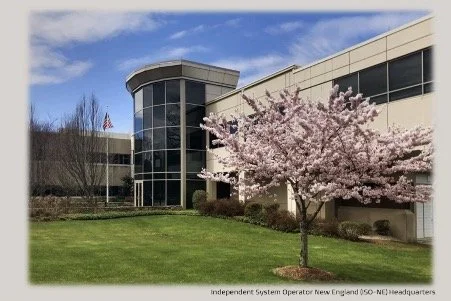
Headquarters of Independent System Operator (ISO) New England
The third and final session held these concerns in productive tension with questions of futures and risk. Canay Özden-Schilling’s presentation opened with a provocation borrowed from historian of technology David E. Nye: it is usually the first blackout a nation experiences that marks the completion of electrification. Özden-Schilling's ethnographic work inside US electricity markets, as explored in her book The Current Economy: Electricity Markets and Techno-Economics (2021), produced an account of how security discourse structures grid expertise and how it consistently fails. This was illustrated through her visiting the headquarters of ISO New England, the independent system operator responsible for the whole of the electrical transmission across the region. The building, a complex of unmarked beige structures in Holyoke, Massachusetts, is one of seven such facilities in the United States. The more critical a node, the more secure it must be, which only demonstrates how vulnerable it is: a cycle that escalates consequences without reducing risk.
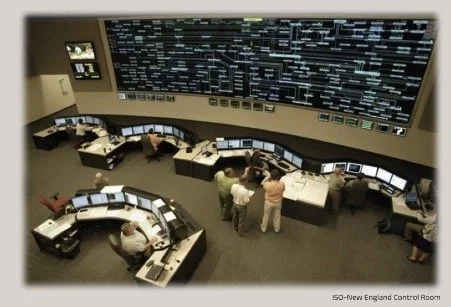
ISO-New England control room
Borrowing from Donna Haraway, Özden-Schilling's proposal to 'stay with the blackout' (the title of one of her recent articles), was a methodological and political injunction to resist the arc, from shock to forgetting that characterises public responses to grid failure, and to ask what alternative socialisations into electricity might look like.
Design anthropologist Abhigyan Singh's work arrived at comparable conclusions from the design end. Singh’s presentation drew on two distinct bodies of fieldwork: eleven months in two remote villages in India with no grid connection, and four years embedded in a large energy transition project in a neighbourhood of south-east Amsterdam to explore what design anthropology can contribute to understanding energy futures at the scale of communities and households. Where Özden-Schilling had approached the grid from its operational centres outwards, Singh approached it from the everyday inwards: attending to the social relations, material practices, and unspoken value systems through which people encounter and make sense of energy infrastructure in their daily lives.
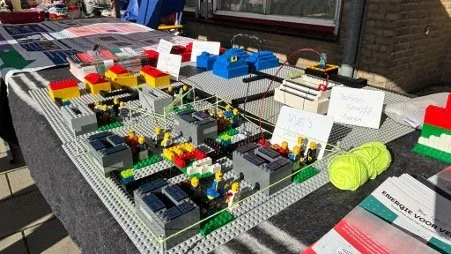
Making ‘Grid’ Futures Understandable (using lego)
The study in India installed a small off-grid solar lighting infrastructure at a volunteer household (Nita Yadav) and used that as the basis for investigating how social relations, caste, kinship, and cultural values shape energy exchanges between households. Singh identified Rampur, an unelectrified village 15km from Gaya city in Bihar, after visiting multiple villages in the district. The key finding is that energy exchange isn't purely rational or market-driven: sharing within family and community operates according to entirely different moral logics than trading with non-kin. This revealed that social bonds and exchange are not just driven by money, and suggested that people could be responsible for their own distribution of energy without a centralised hub.
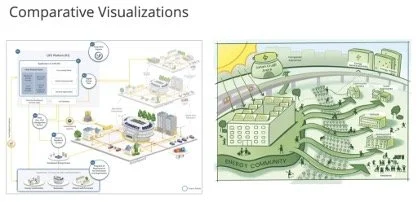
Abhigyan Singh, visualisations of centralised hub (left) and decentralised energy community (right)
Back in the Netherlands, as part of his four-year Amsterdam-area research project presented at Dutch Design Week and to energy companies across the Netherlands, he set two images side by side: the energy company's vision of the future, a clean diagram with no people in it, against the residents' composite image, dense with social and relational mess. For him, design anthropology's task is to hold those two images in relation, keeping the messier one visible rather than letting it be smoothed away. What he found ultimately unsettled both the economic imaginary and the more idealistic communitarian one.
Conclusion
What the three sessions of Grid Imaginaries held in common was not a method or a conclusion but an orientation: a refusal to let electricity become invisible, to reveal the power structures behind it and imagine ways it could be rethought. What these conversations suggested is that this work requires exactly the kind of interdisciplinary dialogue the series was designed to generate; artists and scholars working alongside technologists, strategists, and the public, with methods capable of holding these different perspectives together so that a larger demographic might understand and take ownership of the issues at stake.
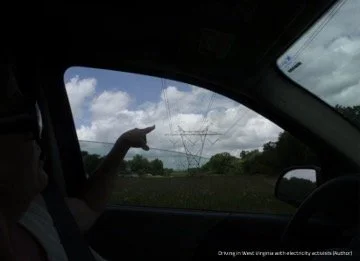
Driving on West Virginia with electricity activists, photo taken by Canay Özden-Schilling
Marjolijn Dijkman
Marjolijn Dijkman is a multidisciplinary artist whose practice operates at the intersection of culture, science, and speculative fiction. Working across film, photography, sculpture, and installation, she develops multiyear, process-based projects that mobilise archival research, fieldwork, and experimentation, resulting in artworks, exhibitions, publications, and discursive events. She is a PhD researcher at KU Leuven and LUCA School of Arts, Brussels, with a thesis titled Beyond the Ruins of the Future examining different ways arts can engage with the climate crisis. She is co-founder of Enough Room for Space, a collaborative platform for artistic research based in Brussels, currently expanding its archive, studios, and facilities.
Dom Davies
Dom Davies is Reader in English at City St George's, University of London, where he convenes the Thinking Through Infrastructure Network (TTiN) and hosts the TTiN Podcast. His research explores the lived experience of infrastructure and the ways it shapes political imagination, connecting infrastructure to histories of empire, nationalism, and cultures of place and belonging in Britain and the post-imperial world. His books include The Broken Promise of Infrastructure (Lawrence Wishart, 2023) and Graphic Refuge (Wilfred Laurier University Press, 2025), and his writing appears in journals including the Journal of Urban History as well as public-facing outlets such as Red Pepper, Tribune, and The Conversation.
Veronica Jacome
Veronica Jacome is a human geographer with a background in physics, holding a PhD in Energy and Resources from the University of California, Berkeley. Her research explores the political and economic histories of electric grid development across the US, Ghana, and Tanzania, examining the relationship between nation-building, capitalist investment, and the uneven reliability of infrastructure across the Global North and South. Her current book, Hooked: Electrification and the Making of the Modern Consumer, traces the long history of electrical reliance in the US, centering ordinary consumers and workers as key actors in the development of large-scale sociotechnical infrastructure. Drawing on BPA and Seattle City & Light archives, the book weaves together the physical history of the grid including voltage fluctuations, outages, standardisation, with the political economies that shaped it.
Jacome is also an artist and ceramicist, using sculpture to express the poetic complexities of infrastructure. She has curated two film series ‘Electric Visions’ and ‘Infrastructural Beings’, drawing on animation, documentary, and experimental film to illuminate the infrastructurally charged dimensions of everyday life.
Helen V. Pritchard
Helen V. Pritchard is an artist-designer, geographer and queer love theorist. Their work considers the impact of computation on social and environmental justice and how this configures the possibilities for life, in intimate and significant ways. Helen is Professor and Head of Research at the Critical Media Lab and Institute Experimental Design and Media Cultures (IXDM), Basel Academy of Arts and Design, FHNW. They also hold an associate professorship in Queer Feminist Technoscience at University of Plymouth and co-organise with The Institute for Technology in the Public Interest (TITiPI).
Canay Özden-Schilling
Canay Özden-Schilling is an anthropologist of capitalism, technology, and infrastructure, researching electricity markets and global port logistics. Her work examines the scientific and technological work cultures that produce and disseminate the economic formations of contemporary life. Her first book, The Current Economy: Electricity Markets and Techno-Economics (Stanford University Press, 2021), is an ethnography of the US electric grid in the age of competitive markets and smart grids, drawing on fieldwork with market data analysts, grid engineers, and citizen activists. Her second book explores global supply chain logistics through the port cities of Mersin (Turkey) and Singapore. She holds a PhD from the HASTS Program at MIT (2016) and an MA in Near Eastern Studies from New York University, and was previously a Mellon-Sawyer Postdoctoral Fellow in Anthropology at Johns Hopkins University.
Abhigyan Singh
Abhigyan Singh is Assistant Professor of Design Anthropology for Social Change at TU Delft's faculty of Industrial Design Engineering and a Research Fellow at the Amsterdam Institute for Advanced Metropolitan Solutions (AMS Institute). His research examines how energy and climate transitions are lived in neighbourhoods across the Global North and South, centring non-market value exchange, fairness, and relationality through hybrid approaches combining design, digital, and traditional ethnography. He has led design-ethnographic studies in India and the Netherlands, serves on the Editorial Board of Designing (Design Research Society), and recently co-led the Social & Economic Value strand of IEA GOP2P (2023–25). Before academia, he worked as a UI designer at Infosys, delivering UX projects for clients including Bank of America and Pfizer. His work has been exhibited at Dutch Design Week.
Further Reading:
Anderson, B. and Torriti, J. (2018) 'Explaining shifts in UK electricity demand using time use data from 1974 to 2014', Energy Policy, 123, pp. 544–557.
Davies, D. (2023) The Broken Promise of Infrastructure. London: Lawrence Wishart.
Davies, D. (2025) Graphic Refuge. Waterloo: Wilfred Laurier University Press.
Özden-Schilling, C. (2021) The Current Economy: Electricity Markets and Techno-Economics. Stanford: Stanford University Press.
Dijkman, M. (2018) Radiant Matter. Eindhoven: Onomatopee. https://www.marjolijndijkman.com/publications
Dijkman, M. and Vanden Eynde, M. (eds.) (2018–2024) On-Trade-Off. Brussels/Lubumbashi: Enough Room for Space/Picha. https://www.enoughroomforspace.org/projects/on-trade-off/
Jacome, V. (forthcoming) Hooked: Electrification and the Making of the Modern Consumer.
Pritchard, H. (ed.) (2022) Infrastructural Interactions: Survival, Resistance and Radical Care. [Manual publication.]
Özden-Schilling, C. (2024) 'Staying with the blackout: an insecure anthropology of energy', Journal of the Royal Anthropological Institute. https://doi.org/10.1111/1467-9655.14160
Singh, A. (2019) Conceptualizing Inter-Household Energy Exchanges: An Anthropology-through-Design Approach. Doctoral dissertation, Delft University of Technology. https://doi.org/10.4233/uuid:57be7165-2726-4a1a-b076-c5ed3988e00b